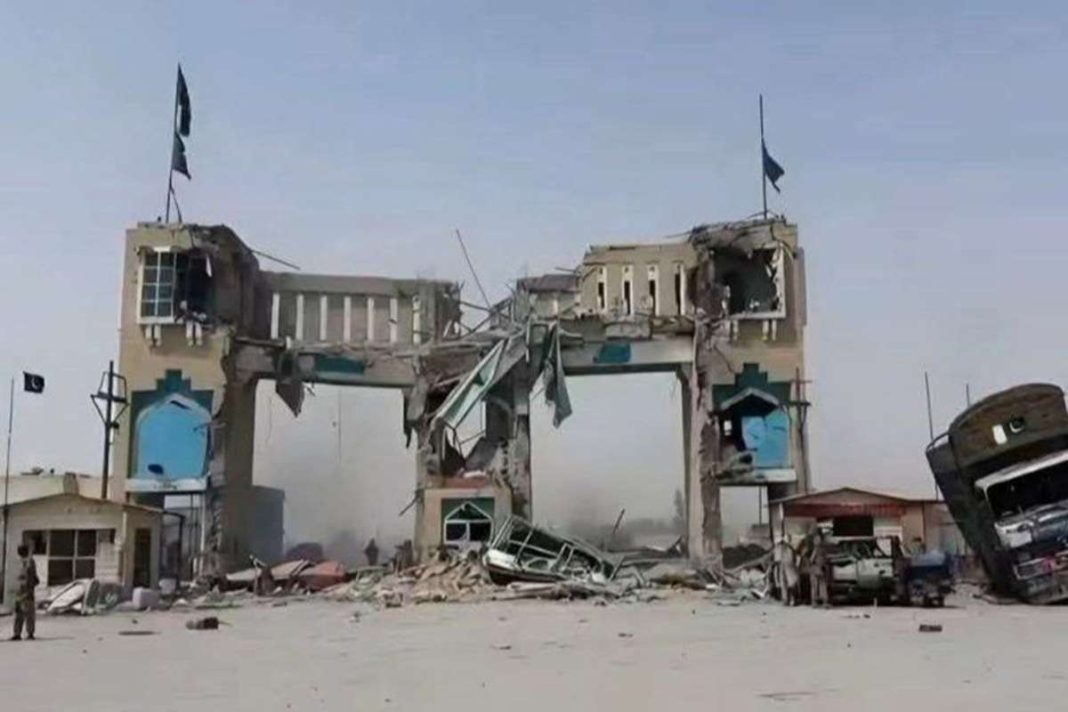
The sight has become familiar along the Chaman–Spin Boldak frontier: artillery craters on both sides, shuttered crossings, and dueling press statements in Kabul and Islamabad. In recent weeks, Afghan Taliban forces and Pakistani troops have again exchanged fire near Chaman, killing civilians and soldiers despite an agreed ceasefire.
Yet even as shells crossed the border, there were news reports that Pakistan quietly allowed the United Nations to move food and medical supplies through Chaman and Torkham into Afghanistan, while keeping trade and travel tightly restricted. The question almost asks itself: how long should Pakistan keep facilitating or funding relief for a neighbor whose rulers constantly treat it as a hostile power rather than a partner?
Taliban officials have spent much of the past two years castigating Islamabad.
Kabul’s spokesmen routinely denounce Pakistan’s closure of border crossings as “illegal” political pressure and demand “firm guarantees” that Islamabad will not use trade routes as leverage. In recent statements, Zabihullah Mujahid has boasted that Afghanistan is meeting its needs through “other countries” and “alternative trade routes” while accusing Pakistan of harming communities on both sides of the border.
Behind this rhetoric lies a deeper dispute. No Afghan government, including both Taliban iterations, has accepted the Durand Line as an international border. Taliban figures and sympathetic commentators often invoke the trope of Afghans having driven out three great powers over two centuries, and now treating Pakistan as a minor nuisance along a frontier they do not legally recognize. The implication is clear: Pakistan is both expendable and somehow culpable for Afghanistan’s problems.
Given this climate, the Afghan social media refrain that “Pakistan fought the Afghan wars for US dollars” has gained new traction. It also demands a reality check.
According to the US Special Inspector General for Afghanistan Reconstruction, Washington appropriated roughly $145 billion for reconstruction and related activities in Afghanistan between 2002 and 2021, including about $88.6 billion for Afghan security forces and $36.3 billion for governance and development. Separate SIPRI estimates suggest that the United States disbursed almost $73 billion in military aid to Afghanistan alone over 2001–2020, nearly twenty times Afghanistan’s own military spending.
Pakistan, by contrast, received a mixture of economic assistance, military aid, and Coalition Support Fund reimbursements. A detailed study of US aid to Pakistan between 2001 and 2020 puts total USAID economic support at about $10.7 billion over two decades. The US embassy in Islamabad notes that, over roughly 20 years, total US assistance to Pakistan has barely exceeded $32 billion, including military support and reimbursements under the Coalition Support Fund for costs incurred in counterterrorism operations.
These figures do not describe “payment for fighting Afghanistan’s war.” They represent a transactional arrangement in which Pakistan aligned with the United States to manage its own security and strategic interests, and received partial reimbursement for the very real economic and security damage inflicted on its territory. During the post-9/11 period, Pakistan suffered more than 80,000 casualties in terrorism-related violence and hundreds of billions of dollars in economic losses, according to several Pakistani and academic estimates. It is hard to see how this qualifies as a profitable venture.
The financial picture since the Taliban’s return to Kabul only sharpens this contrast. UN figures show that from August 2021 to late 2024, Afghanistan received about $6.7 billion in humanitarian funding. A recent US watchdog report calculated that, from August 2021 through April 2025, international donors provided roughly $10.7 billion in aid to Afghanistan, with about $3.8 billion from the United States.
Pakistan, facing its own balance-of-payments crisis, spiraling inflation, and IMF obligations, has received nothing comparable in that period for its Afghan-related burdens. If anyone now lives on infusion after infusion of foreign dollars, it is the regime in Kabul, not Islamabad. That alone should sober those who still chant that Pakistan made money from Afghan tragedies.
None of this denies that Afghanistan faces a grave humanitarian crisis. UN OCHA’s latest planning documents estimate that 22.9 million Afghans, almost half the population, will require humanitarian assistance in 2025, down only slightly from 23.7 million in 2024. Food insecurity remains above pre-2021 levels, with about 14.8 million people severely food insecure, and basic services such as health and education have deteriorated sharply under Taliban rule.
However, the Taliban government bears direct responsibility for much of this suffering. Its systematic exclusion of women from secondary and higher education, many jobs, and public life has crippled the very human capital that any modern economy needs. Its restrictions on women aid workers have repeatedly forced international agencies to scale down or suspend programs. Recent findings by the US Special Inspector General for Afghanistan Reconstruction allege that Taliban officials divert aid, tax it, and sometimes channel it to favored areas and security units, including training camps. In plain language, the regime treats humanitarian flows as a political asset and a revenue stream.
In this situation, the argument that Pakistan must keep paying into Afghan relief begins to look less like compassion and more like self-harm.
Pakistan faces a clear security problem emanating from Taliban-run Afghanistan. Islamabad alleges, and many independent analysts agree, that the banned Tehrik-e-Taliban Pakistan uses Afghan territory to train fighters, regroup, and plan attacks. Pakistani officials stated in 2023 that 14 out of 24 suicide bombings that year involved Afghan nationals. At the same time, the Taliban leadership in Kabul insists that Afghan soil poses no threat and treats Pakistan’s complaints as mere political rhetoric.
In response, Pakistan has begun to deport undocumented Afghans, estimated at around 1.7 million people, as part of a broader security strategy. This policy imposes human costs and deserves scrutiny. Still, it reflects a fundamental reality: a state under sustained cross-border attack will eventually prioritize security over hospitality, especially when it has hosted millions of refugees for more than four decades.
Border clashes add another layer to this calculus. Incidents at Torkham and Chaman, with Afghan forces initiating or escalating fire, have killed Pakistani civilians and soldiers and repeatedly shut down trade. Yet Kabul’s public line often casts Pakistan as the aggressor and then boasts of seeking “better” trade partners elsewhere.
Against this backdrop, calls for Pakistan to provide bilateral humanitarian assistance to Afghanistan ring hollow. Pakistan already pays in blood and treasure for Afghan instability. It hosts Afghans, absorbs the economic shock of border disruptions, and faces terror attacks with roots in sanctuaries across the line. The idea that it must also underwrite the Taliban’s misgovernance through direct relief funds ignores both security logic and fundamental fairness.
A more coherent policy would rest on three pillars.
First, Pakistan should stop providing direct humanitarian assistance from its own budget to the Taliban-run state. Global donors that choose to work in Afghanistan can route aid through UN agencies and NGOs, while negotiating their own safeguards against diversion. Pakistan can allow tightly regulated transit for such assistance when it serves broader international objectives, but it should not write cheques against its own thin fiscal space.
Second, Islamabad must press ahead with a rules-based management of Afghan presence in Pakistan. That includes continued deportation of undocumented individuals in line with national law and international norms, a clear pathway for documented refugees under time-bound arrangements, and rigorous screening to disrupt terror facilitation networks. The goal is not collective punishment, but the removal of the support infrastructure on Pakistani soil for groups like TTP.
Third, Pakistan should maintain a posture of firm deterrence on the border. Every shot fired across into Pakistani territory deserves a calibrated, lawful response that signals cost without spiraling into uncontrolled escalation. A state that ignores repeated armed provocations on its frontier invites more of them.
Critics will argue that such a hard line undermines Pakistan’s long-standing claim to stand with the Afghan people. The answer is simple: solidarity with ordinary Afghans does not require subsidizing an openly hostile regime. Forty-plus years of hosting refugees, opening markets, and absorbing blowback from jihad and counter-jihad have already demonstrated Pakistan’s generosity. That generosity has rarely changed Afghan elite narratives about Pakistan, especially among Taliban and ultra-nationalist circles.
Pakistan has spent decades behaving like a benevolent state in a very rough neighborhood. It opened its borders in 1979, accepted wave after wave of refugees, and then aligned with the United States to prevent further chaos from spilling over. Much of that goodwill has evaporated in Afghan public discourse, replaced by accusations and conspiracy theories.
There is no shame in a course correction. A more “selfish” Pakistan in policy terms would do what most states already do: put its territorial integrity, economic stability, and social cohesion first. In the current environment, that means declining to fund humanitarian assistance to Afghanistan, while allowing the international system to carry that burden if it chooses. It means seeing Afghan suffering clearly, but also seeing who governs Kabul, who shelters anti-Pakistan militants, and who fires the first shots at Chaman.
Pakistan owes the Afghans honesty about that reality. It does not owe the Taliban a blank cheque wrapped in the language of compassion.