

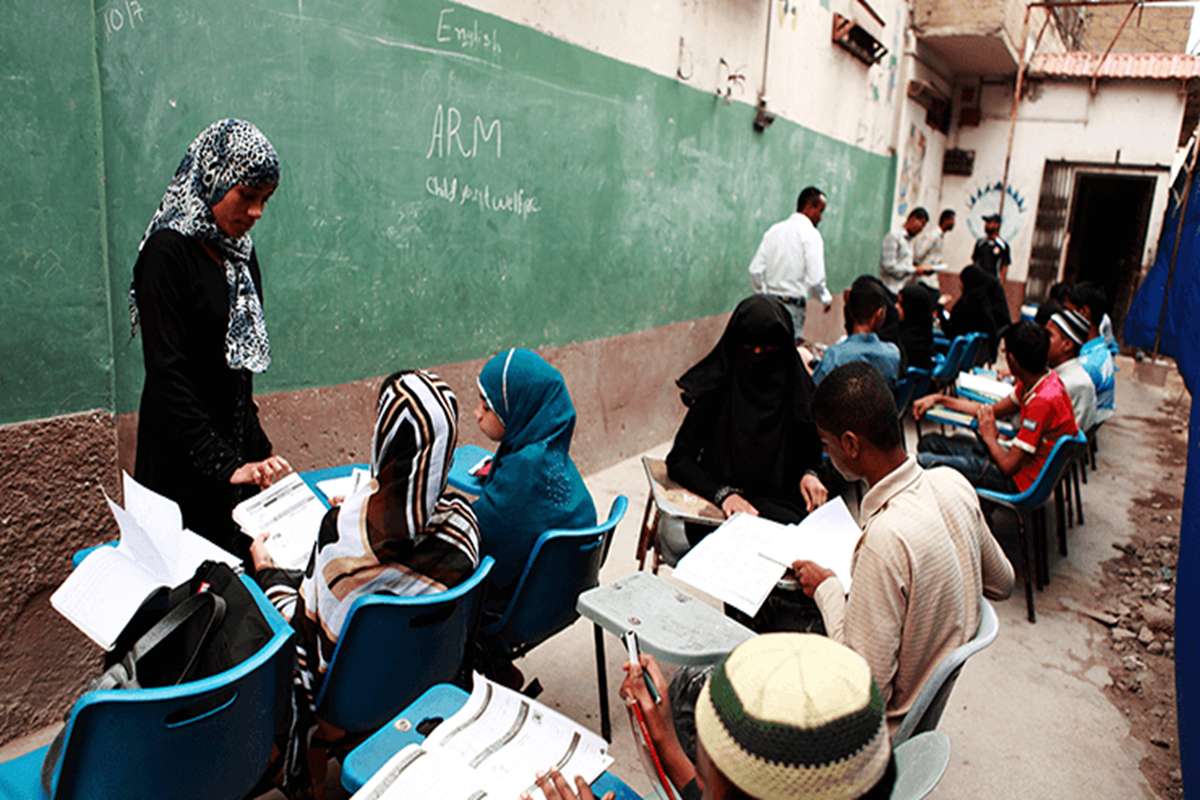
Featured image courtesy: https://wenr.wes.org/2020/02/education-in-pakistan
Article 25-A of Pakistan’s Constitution quietly turned fifteen this year. It promises free and compulsory education for every child aged 5 to 16. Yet the latest census data still puts national literacy at 60.6 percent, with roughly 60 million Pakistanis unable to read or write a simple sentence. The gap between a fundamental right and lived reality has grown into a kind of national blind spot. Talk shows dissect every politician’s statement, but rarely ask provincial governments why a constitutional guarantee of education has remained largely aspirational. Controversy draws ratings; literacy does not.
The legal architecture itself reinforces this political indifference. The 18th Amendment in 2010 shifted education squarely to the provinces, while inserting Article 25-A into the chapter on fundamental rights. The text places the obligation on “the State,” but in practice, the provinces control schools, teachers, and curricula. The federal Ministry of Federal Education and Professional Training retains some policy and coordination roles, but no direct authority to compel a province to meet any specific literacy target.
In effect, Pakistan constitutionalized a right without building an enforcement mechanism. Devolution increased provincial autonomy, but not provincial accountability.
Money should have been the obvious way to track seriousness. Recent estimates by the Pakistan Institute of Education and allied partners show that in FY 2022-23, combined federal and provincial education budgets reached about Rs 1.345 trillion, roughly 7 percent of total public outlay. Even so, various assessments place Pakistan’s education spending at 1.7-2.8 percent of GDP, far below UNESCO’s 4–6 percent benchmark.
In other words, the State has treated a fundamental right with a budget closer to a discretionary social program.
Within that national envelope, provincial choices matter. Analysis of public financing data for 2020-21 suggests that education consumed about 17 percent of Balochistan’s budget and around 20 percent of Sindh’s. Khyber Pakhtunkhwa went further on paper, earmarking roughly 25 percent of its 2022-23 budget, about Rs 308 billion, for education. Punjab allocates the largest absolute sum, running into several hundred billion rupees annually. Yet across provinces, more than four-fifths of these budgets typically go to salaries, leaving limited space for improving infrastructure, materials, or teacher support. When politicians boast of “record” allocations, they seldom explain how much of it reaches classrooms as better learning, rather than as a larger wage bill within an underperforming system.
The literacy data tell the story of this underperformance.
According to the Labour Force Survey 2020-21, national literacy (age ten and above) stood at 62.8 percent, barely up from 62.4 percent in 2018-19. Punjab led with 66.3 percent, followed by Sindh at 61.8 percent, Khyber Pakhtunkhwa at 55.1 percent, and Balochistan at 54.5 percent. These are not terrible numbers for a poor country, but they represent glacial progress in a youthful society that has poured billions into schooling. The 2023 census-based estimates sharpen the picture. They place overall literacy at 60.6 percent, with provincial rates of about 66.25 percent in Punjab, 57.54 percent in Sindh, 51.09 percent in Khyber Pakhtunkhwa, and only 42.01 percent in Balochistan. The provincial ranking remains the same, but Balochistan now trails Punjab by more than 24 percentage points.
Different survey methodologies explain part of the gap, yet the direction of inequality is unmistakable.
What has changed since 2010, when Article 25-A was added to the Constitution?
National adult literacy hovered around the high-50s in the early 2010s and has edged up only modestly since then. The Labour Force Survey figures show improvements of just a few percentage points over the past decade, while the census confirms that large pockets of the country, especially rural Balochistan and parts of Khyber Pakhtunkhwa and Sindh, remain functionally illiterate.
The devolution bargain promised that provinces would understand local needs better and innovate faster. The data suggest something closer to managerial drift.
Regional comparison makes the cost starker.
India’s latest Periodic Labour Force Survey puts literacy for those aged seven and above at about 80.9 percent. Bangladesh’s adult literacy reached roughly 79 percent by 2022. Nepal’s adult literacy stands around 71–76 percent, depending on whether one uses World Bank or census data. Sri Lanka sits in a different league altogether, with adult literacy above 92 percent. Pakistan is the outlier in this group, despite having per capita income comparable to or higher than Bangladesh’s and Nepal’s for much of the period.
In South Asia’s classroom, Pakistan is the child who keeps repeating the same grade.
Even these headline literacy rates flatter the system because they do not capture “meaningful literacy.” The Annual Status of Education Report (ASER) 2023, which tests children’s ability to read simple stories and perform basic arithmetic, finds that only about half of grade 5 children can read a grade 2-level story in Urdu or a provincial language, and only 46 percent can solve a two-digit division problem. A recent analysis of foundational learning notes that Pakistan spends about 1.7 percent of GDP on education, that teacher salaries account for over 80 percent of education budgets, and that many teachers remain unprepared to teach reading and numeracy in the early grades. In plain terms, millions of children sit in classrooms, but half leave primary school unable to read a short local-language story with ease or handle everyday numbers.
Provinces have met the politics of schooling; they have not met the promise of literacy.
This is not simply a story of poverty or demography. It is also a story of incentives. Provincial governments win elections on visible patronage: teaching jobs, school buildings, and road projects that lead to those schools. Learning outcomes do not feature in campaign speeches or in negotiations over the National Finance Commission Award. Education departments remain highly centralized and bureaucratic, while head teachers often have little financial or managerial autonomy. The system rewards compliance and loyalty more than performance. In such an environment, a district officer who quietly improves reading in grade 3 wins less political capital than one who cuts a ribbon on a new boundary wall.
The federal government has treated this drift as a constitutional fait accompli rather than a political challenge. After the 18th Amendment, Islamabad largely avoided serious efforts to renegotiate the balance of responsibility on education or population. It has issued frameworks and policies, including the National Education Policy Framework and recent foundational learning strategies. Still, it has not tied federal transfers or national reputation to concrete provincial results on Article 25-A. The Council of Common Interests could have adopted minimum national standards for literacy and numeracy, mandated regular publication of province-wise scorecards, and linked a small but visible portion of federal transfers to progress on those metrics. That conversation has barely begun.
Reclaiming education entirely for the federation would be politically explosive and arguably unrealistic. Yet the current arrangement, in which the federal government funds a large share of provincial budgets through the NFC while exercising almost no leverage on how well children learn, also makes little sense. A more honest bargain would establish nationally agreed floor standards for foundational learning, require transparent reporting on provincial budgets and outcomes, and earmark a performance-linked tranche of federal transfers for education and population. Provinces that deliver real gains in literacy, especially for girls and the poorest districts, should receive more fiscal space and more political credit. Those who do not should at least face challenging questions in Parliament and in the media.
At the individual level, illiteracy locks a person out of modern life. At the national level, it locks a country into low productivity, low trust, and low growth. Pakistan cannot hope to compete in any serious regional or global economy while it leaves four out of ten citizens unable to read with understanding. Treating that neglect as a routine side effect of political churn is, at the very mildest, a kind of civic criminality. Article 25-A promised education for all; 15 years later, Pakistan has primarily delivered talk, not action. Until provincial chief ministers, opposition leaders, and federal ministers feel that their careers depend on how many children can read a local language story and solve a simple sum, rather than on how many scandals they can survive on television, the country will continue to promote illiteracy by default.


