The years between August 2018 and April 2022 are now wrapped in a haze of nostalgia in parts of Pakistan’s public debate. On social media, Imran Khan’s government is often portrayed as a near-miraculous reform period derailed by conspiracy. The data tell a different story. When the four years are examined through the hard lens of United States dollars rather than emotional rhetoric, they look much more like a period in which Pakistan’s fiscal capacity, financial markets, and strategic leverage were quietly weakened.
For clarity, the figures below use approximate average exchange rates: around Rs100–105 per dollar in FY2017–18, and roughly Rs175–177 per dollar in FY2021–22. That simple change in the rupee’s price is central to the story. Sectors that appeared stable or even growing in rupee terms often shrank in dollar terms. For an import-dependent economy with heavy external debt, dollar capacity is what ultimately matters.
The central argument is direct. Under Imran Khan, Pakistan’s core domestic revenue engines were strained without building real dollar strength, the stock market lost nearly half its value in dollar terms, and the defense budget’s purchasing power stagnated amid rising internal and regional threats. Populist language hid a balance sheet that was becoming more fragile.
Domestic Revenue Engines: Running Harder to Stand Still
Pakistan’s tax system leans heavily on a handful of sectors that generate large shares of indirect taxes: energy, tobacco, telecom, cement and construction, and consumer goods such as sugar and beverages. These are the engines that finance everything from debt servicing to security operations. Looking at their performance between FY2017–18 and FY2021–22 shows why the period cannot honestly be described as a fiscal success.
Energy is the most critical example. In FY2017–18, combined federal sales taxes and levies on petroleum products and electricity totaled around Rs750 billion, translating at prevailing rates into roughly $7–8 billion of central government revenue from the energy chain. By FY2021–22, rupee collections were significantly higher, driven by rising fuel and power prices and growing nominal consumption. However, once those rupees are converted at around Rs176 per dollar, the resulting dollar revenue was broadly flat and, in some components, lower than four years earlier.
This meant that households and firms were paying more in local currency to maintain the state’s external capacity. At the same time, circular debt in the power sector kept accumulating, reaching around $15 billion in unpaid obligations, i.e., about 3.8% of the country’s GDP and 5.6% of the total government debt. Instead of turning energy into a strong, predictable fiscal anchor, the government presided over a system in which higher local prices did not translate into stronger dollar resilience.
Tobacco and cigarettes tell an even sharper story.
The federal excise duty on cigarettes is one of Pakistan’s most reliable tax instruments, provided enforcement is serious. In FY2017–18, cigarette excise collection was about Rs117.2 billion. At around Rs105 per dollar, that was roughly $1.1 billion. By FY2021–22, nominal excise receipts had risen to Rs149.5 billion, yet this translated into only about $0.85 billion at roughly Rs176 per dollar. The state’s dollar revenue from a key tax handle fell by around one quarter during a period when nominal rates were raised and inflation was high. That decline cannot be explained away as an accounting curiosity. It signals that enforcement against illegal cigarettes and tax evasion did not keep pace. While slogans about corruption and reform dominated the airwaves, one of the few sectors where the government could have locked in a strong and transparent tax stream ended up contributing less in real terms.
Telecommunications, another pillar of indirect taxation, followed a similar pattern. Consumers faced a heavy general sales tax on voice and data, as well as a complex web of withholding charges. Data usage grew rapidly during 2018–2022, and rupee revenues from telecom services increased. Yet when those collections are viewed in dollars, the rise is modest. If combined telecom-related taxes were roughly $900 million in FY2017–18 and just over $1 billion by FY2021–22, that increase barely kept pace with population growth. It did not reflect the scale of the digital boom.
A healthy, well-regulated telecom sector could have become a significant growth and revenue story by the early 2020s. Instead, policy uncertainty, high usage-based taxation, and currency depreciation limited its ability to expand the formal tax base in hard currency. The state was essentially taxing usage heavily without translating it into a major dollar dividend.
Cement and construction materials provide another instructive case. Cement carries federal excise duty, while construction inputs face sales tax. In FY2017–18, excise duty on cement yielded about Rs60 billion, equivalent to roughly $570 million. By FY2021–22, collections had risen in rupees to around Rs73.5 billion. However, when converted at around Rs176 per dollar, this is only about $420 million, implying a fall of around one quarter in dollar revenue.
This contraction reflects a stop-start construction cycle. Government “packages” encouraged speculative activity, but cuts in public sector development spending and high interest rates slowed real, productive construction. The much-hyped construction amnesty and housing schemes did not translate into a durable, well-taxed growth sector. Instead, they left the fiscus no stronger externally while adding to policy volatility and expectations of special treatment.
Sugar, beverages, and fast-moving consumer goods complete the domestic picture. These sectors generate substantial sales tax and, in some cases, excise duty. Over the PTI period, rupee collections from sugar and beverages rose, and in dollar terms may have moved from roughly $1.4–1.5 billion in FY2017–18 to around $1.6 billion by FY2021–22. That is a small real gain over four years in sectors characterized by rising prices and a growing population.
The period was also marred by repeated sugar price spikes, export cycles that enriched a narrow set of millers, and public scandals around inquiries that went nowhere. The outcome, in terms of revenue, was underwhelming. The state extracted more from consumers without creating a meaningfully larger and cleaner tax base.
Across these five engines, a pattern emerges: In rupee terms, tax receipts increased. In dollar terms, which determine the country’s capacity to service external obligations and pay for imports, the advance was weak and, in some cases, outright negative. Pakistan’s fiscal machinery was running harder to avoid sliding backwards. That is not the mark of a successful economic stewardship.
The PSX in Dollars: A Quiet Collapse
While revenue was eroding externally, Pakistan’s primary capital market saw a steep decline in its international footprint. The government often pointed to the KSE-100 index level in rupees as proof that investor confidence remained intact. The dollar figures say otherwise.
At the close of FY2017–18, the Pakistan Stock Exchange’s total market capitalization was around Rs8.7 trillion. With the exchange rate near Rs105 per dollar, that represented roughly $82–83 billion of listed equity value. Pakistan was not a giant in global terms, but its market was meaningful enough to attract some foreign portfolio attention.
By April 2022, the KSE-100 index in points had fluctuated but not collapsed. However, the rupee had. If market capitalization was roughly Rs7.7–8.0 trillion around that time, and the average exchange rate was about Rs175–177 per dollar, then the market’s dollar value had fallen to roughly $44–46 billion. In less than four years, the external value of Pakistan’s listed companies had dropped by around 40–45 percent.
Foreign investors saw that contraction clearly. Net foreign portfolio flows were negative, and the market became too small in dollar terms to matter much for major global funds. A country already struggling to attract long-term investment thus emerged from the PTI period with a significantly shrunken equity footprint.
A government that had promised to make Pakistan a magnet for capital instead presided over a near-halving of the stock market’s dollar value. That damaged not only foreign perceptions but also domestic confidence. Pension funds, insurance companies, and ordinary investors all absorbed the cost of a market that shrank in international purchasing power even when its domestic index did not appear to collapse.
Shrinking Strategic Leverage
Economic performance is not only about comfort and consumption. For a country with Pakistan’s geography and security burdens, it is also about strategic leverage. Defense spending, internal security budgets, and the ability to maintain credible deterrence all rest on economic foundations.
In nominal rupee terms, Pakistan’s defense budget rose gradually between 2017 and 2022. When converted to current dollars, however, it remained broadly within the $10–11 billion a year range, with little real increase. At the same time, the costs of imported fuel, spare parts, and equipment climbed, and the rupee’s slide made every dollar more expensive.
In practice, this meant that Pakistan’s armed forces and internal security institutions were being asked to manage rising threats with a flat external budget. The Tehrik-e-Taliban Pakistan regenerated across the border. The terrorist activity evolved in Balochistan. The situation on the eastern border remained tense. Meanwhile, rival states deepened their own economic and technological bases.
A stagnant or shrinking dollar economy limits the state’s ability to invest in training, technology, and logistics. It narrows the range of options in a crisis. It also reduces diplomatic leverage; partners and rivals alike can see when a country’s underlying capacity is weakening.
The PTI years thus not only weaken Pakistan’s fiscal resilience and capital markets. They also left the country with less practical room to manoeuvre in a dangerous region. Populist slogans and confrontational speeches did not compensate for that quiet loss of capacity.
Populism and the Cost of Amnesia
Taken together, the evidence across domestic revenues, capital markets, and strategic spending leads to a clear conclusion. Between August 2018 and April 2022, Pakistan became more fragile in dollar terms. Core tax bases were squeezed without building real external strength. The stock exchange lost almost half its international value. Defense purchasing power stagnated even as threats multiplied.
Yet in large parts of the public debate, these years are being remembered as an almost heroic interlude. Social media narratives focus on style, grievance, and conspiracy rather than on revenue lines, market capitalisation, or the currency’s collapse. The risk is that, by forgetting the actual economic record, Pakistan will repeat the same experiment with populism and expect different results.
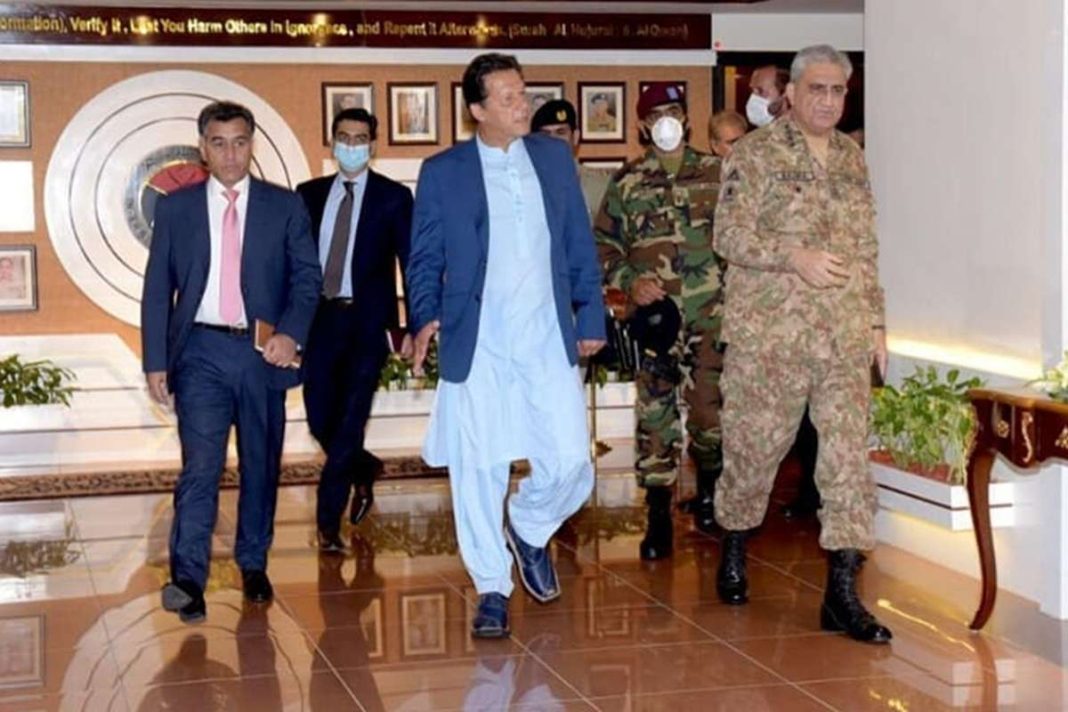
There is also a lesson for the institutions that midwifed that experiment. Imran Khan’s rise and survival owed much to segments of the military establishment that believed he would deliver a cleaner, stronger system. Instead, the country emerged with weaker numbers and deeper polarization. One can only hope that the “General Bajawsque” and “General Faizsque” schools of thought have absorbed the cost of their choices.
Populism often offers a shiny shell without a nut inside. It looks attractive and sounds satisfying when tapped, but when people finally bite down on it, the shell only injures the mouth and draws blood. The years 2018–2022 were such a shell: rich in rhetoric, poor in substance. Pakistan cannot afford to be deceived again by volume and spectacle. The arithmetic of those years is straightforward, and it is unforgiving.
Remembering that arithmetic is not an academic exercise. It is a precondition for avoiding another cycle in which the country’s economic base is eroded while the noise machine insists that everything is improving.
Numbers are harder to manipulate than narratives. In judging Imran Khan’s tenure, Pakistan would do well to listen to them.