

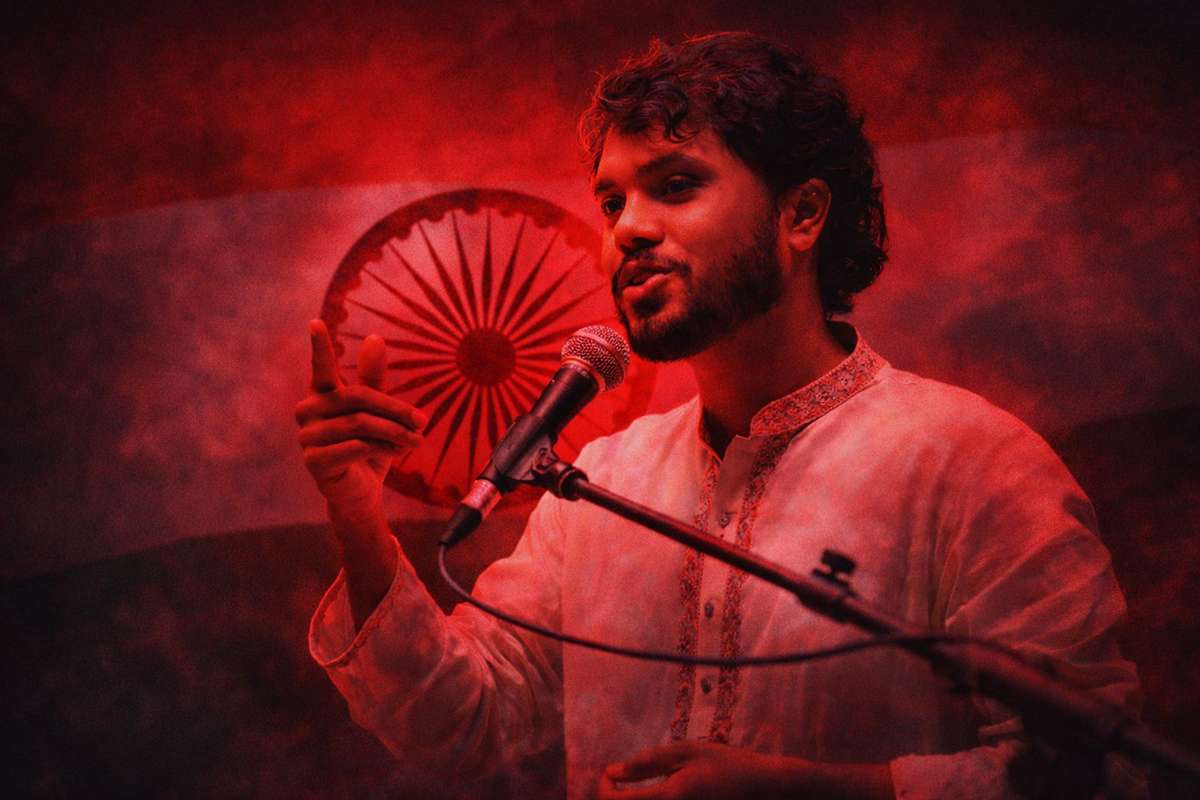
The assassination of Sharif Osman Hadi in Dhaka last week was brazen even by Bangladesh’s turbulent standards. Masked gunmen on a motorbike stalked the 32-year-old student leader in broad daylight, shooting him in the head as he campaigned for February’s election. Hadi – a fiery activist who helped oust former Prime Minister Sheikh Hasina in last year’s uprising – clung to life for six days before succumbing to his injuries in a Singapore hospital.
His death triggered an eruption of anger on the streets of Bangladesh. Protesters torched symbols of the old regime and even attacked the Indian diplomatic mission in Chittagong, driven by a furious belief that Hadi’s killing was not an isolated political hit, but the handiwork of the Indian state.
This widely shared suspicion is not without basis.
Hadi was openly anti-India, and Bangladeshi authorities say the prime suspect “most probably fled to India” after pulling the trigger – a revelation that sparked a diplomatic showdown between Dhaka and New Delhi.
In a chilling twist, a former Indian Army colonel, later identified as Col (Retd.) Ajay Kumar Raina posted a cryptic message on social media – “Hasnat after Hadi” – just as another Bangladeshi youth leader, Hasnat Abdullah, began echoing Hadi’s anti-India rhetoric. Many in Bangladesh interpreted the colonel’s words as an open threat, implying that Hadi’s fate was a warning of more assassinations to come. In the court of public opinion across South Asia, India’s alleged role in this murder has only reaffirmed a pattern: the Republic of India, under Narendra Modi’s watch, increasingly behaves like a republic of assassins, striking dissidents beyond its borders under a cloak of impunity.
Each time India is caught (or credibly accused of) running an assassination or terrorist ring abroad, the reaction from the so-called civilized world is a masterclass in looking the other way. Western governments, ever fond of lecturing others on the rules-based order, suddenly lose their tongue when the offender is India. One can almost picture the hushed chuckles in important capitals of the Western world: better not to make a fuss, lest we upset our “strategic partner” – and anyway, there is always the next arms deal or investment round to consider.
This routine of willful blindness has played out again and again, effectively emboldening New Delhi’s most dangerous instincts. As India works down its international hit list, much of the modern world seems to be winking at the carnage and impatiently awaiting the subsequent assassination, rather than demanding answers or justice.
The killing of Hadi, ghastly as it was, is only the latest data point in a mounting dossier of India’s covert violence overseas.
In September 2023, Canada’s Prime Minister Justin Trudeau shocked Parliament by accusing India’s government of involvement in the murder of Hardeep Singh Nijjar, a Canadian citizen and Sikh separatist leader, on Canadian soil. Trudeau’s statement – backed by intelligence “credible allegations” – detonated a diplomatic crisis. New Delhi huffed and dismissed the charge as “absurd,” but the damage was done. For the first time, a leader of a Western democracy had publicly named and shamed India for extraterritorial assassination. Canada expelled an Indian diplomat (reportedly a RAW intelligence station chief in Ottawa), and India retaliated in kind. The episode laid bare an ugly reality long whispered within diaspora communities. It also tested the principles of India’s Western partners.
The initial response from Washington and London was tepid – expressions of “concern” and calls to “investigate,” carefully calibrated to avoid entirely endorsing Trudeau’s claim. The United States, the United Kingdom, and Australia (all fellow members of the Five Eyes intelligence alliance) backed Canada rhetorically to an extent. Still, none confronted India head-on or imposed consequences. In effect, they signaled that Delhi might get a pass on this egregious transgression, so long as the alliance with India – seen as a bulwark against China – remained advantageous.
Yet the signs of India’s globe-trotting hit squads became harder to ignore as more evidence emerged.
Just weeks after the Nijjar murder, US authorities rolled out a stunning indictment that directly tied India to a foiled assassination plot in New York City. In late 2023, the US Department of Justice charged an Indian citizen, working at the behest of an Indian government official, with conspiring to hire hitmen to kill a Sikh-American activist in New York. According to the DOJ and FBI, the accused, one Nikhil Gupta, agreed to pay $100,000 to have the target – a prominent Sikh lawyer advocating for Khalistan (an independent Sikh homeland) – eliminated. Gupta was arrested in a third country (the Czech Republic) and extradited to the US before the murder could be carried out. Perhaps the most damning detail was what Gupta told the undercover agent he believed was a hitman: he indicated the job was part of a much broader campaign. After a Sikh leader was gunned down in Canada, Gupta boasted that the Canadian victim “was also the target” and that “we have so many targets.” In other words, Indian agents allegedly had a kill list spanning continents.
US intelligence reportedly found the claims severe enough that CIA Director William Burns and Director of National Intelligence Avril Haines raised the issue directly with Indian officials months later. That quiet diplomacy, rather than public censure, illustrated the dilemma: Washington is alarmed by India’s behavior but not yet willing to truly call Delhi to account in the open. Meanwhile, the pattern of transnational repression by India continues to grow – not just against Sikh separatists but Kashmiri dissidents, Muslim activists, and even rival nations’ interests.
India’s covert operations are not confined to North America. In the Middle East and South Asia, Indian intelligence has been busy forging alliances in the shadows – often in cahoots with Israel – to advance its strategic aims through sabotage and assassination.
Iran has explicitly accused India of complicity in espionage and subversion on Iranian soil. In July 2025, Iran’s Islamic Revolutionary Guard Corps (IRGC) conducted a major sweep near the strategic port of Chabahar and arrested 141 people linked to an Israeli Mossad spy ring – astonishingly, 121 of them were Indian nationals. Tehran’s investigation revealed encrypted comms equipment, surveillance gear, and ties to militant groups like the Balochistan Liberation Army (BLA) among the haul. It appeared that India’s Research and Analysis Wing (RAW) had extended its footprint into Iran, leveraging the Iran-India friendship (and India’s access to Chabahar Port) as cover for Mossad-backed clandestine operations.
Iranian intelligence officials uncovered what was dubbed “Project Gidon-Esha,” a secret program aimed at using Iranian territory to destabilize neighboring Pakistan’s Balochistan region. Money flowed through shell companies in Mumbai to arm and fund militants, effectively meaning India was partnering with Israel’s Mossad to run covert actions inside Iran and Pakistan at once. For Iran, this was a grave breach of trust – a supposed regional partner behaving like an Israeli proxy and undermining Iran’s security from within. Tehran publicly fumed that India’s activities “strain bilateral ties and regional stability.”
Meanwhile, Qatar found itself entangled in India’s clandestine web through an espionage case that made global headlines in late 2023. A Qatari court convicted eight Indian nationals – all former officers of the Indian Navy – of spying for Israel and sentenced them to death. The men had been quietly arrested in Doha in 2022 and accused of sharing sensitive information about Qatar’s submarine program with Israeli intelligence, presumably via an Indian-Israeli corporate front. Both the Indian and Israeli governments mainly stayed mum on specifics, but sources confirmed the charge: the Indians were caught acting as Israeli spies in the Gulf emirate. This scandal – which saw India’s typically boastful media go uncharacteristically silent – underscored how deep the India-Israel intelligence partnership has grown. From Iran’s borderlands to the Gulf states, Indian operatives have become an integral part of Mossad’s footprint, providing manpower and local access for operations that neither country wants to admit to. The Qatar case was a rare occasion when the curtain slipped, revealing India’s “shadow workforce” enabling foreign covert agendas. New Delhi’s response was limited to perfunctory expressions of shock and back-channel pleas for clemency, confirming by its very sheepishness that something was amiss.
In South Asia itself, India’s neighbors have long accused it of meddling and militancy – but now those accusations carry new weight.
Bangladesh, currently under a caretaker government, has seen a spike in violent anti-India sentiment following Hadi’s assassination. Even before Hadi’s murder, Bangladeshi activists were circulating leaked audio clips (of disputed authenticity) suggesting ex-Prime Minister Hasina – now in exile in India – was plotting from abroad. After Hadi was shot, the slogan “Boycott India” rang out in Dhaka’s streets, and an ultra-nationalist student leader openly threatened to help “separate the Seven Sisters” (India’s northeast) from India as retaliation. Instead of introspection, India’s response was indignation: it summoned Bangladesh’s envoy to complain about “extremist” rhetoric. The irony of the situation – a regional giant possibly carrying out attacks abroad, yet crying foul when the anger boils over – is not lost on ordinary Bangladeshis. They see an India that talks of friendship but seemingly uses murder as a political tool in their country.
No country has been more vocal about India’s covert hostility than Pakistan, which for decades has faced Indian interference in its restive provinces.
Islamabad’s complaints were often shrugged off in Western capitals as routine South Asian mud-slinging – but in light of recent events, they warrant a fresh hearing. Pakistan’s officials have amassed what they call a mountain of evidence that India sponsors terrorism on Pakistani soil, and they have aired these claims on global forums.
In November 2020, Pakistan’s Foreign Minister and military spokesman presented a dossier of “irrefutable evidence” detailing India’s financing, training, and arming of terrorist groups ranging from the Pakistani Taliban (TTP) to Baloch separatists. The dossier – later handed to the UN Secretary General – contained specifics: dates of RAW handlers’ meetings with militants, audio intercepts of Indian agents coordinating attacks, and bank transfers from Indian accounts to insurgent operatives. India, unsurprisingly, dismissed it all as “lies,” but Pakistan’s case has only strengthened over time.
Consider Balochistan, Pakistan’s mineral-rich but insurgency-hit province. Brahamdagh Bugti, one of the top Baloch rebel leaders, has openly been courted by India. The grandson of the famed rebel Nawab Akbar Bugti, Brahamdagh, fled Pakistan in 2006 and eventually landed in Geneva. In 2016, frustrated with Switzerland’s slow asylum process, he announced he would seek asylum in India, thanking India’s Prime Minister Modi for championing the Baloch cause in an Independence Day speech. India at the time hinted it was considering his request. (For Pakistan, this was vindication of its claims – “everything Pakistan has been saying about the Indian government is proving true,” as one commentator put it.) Brahamdagh’s asylum in India never materialized, but Pakistan asserts that India provided him with funding and a base to direct terror in Balochistan through his Baloch Republican Army (BRA).
In 2017, Pakistan approached Interpol for arrest warrants against Brahamdagh and another exiled Baloch leader, Harbiyar Marri. Officials noted that Brahamdagh had applied for asylum in India after Switzerland rejected his request, underscoring India’s willingness to host figures Pakistan deems terrorists. Around the same time, BLA militants put up “Free Balochistan” propaganda posters in Geneva – an embarrassment that led Pakistan’s envoy to accuse the BLA of “doing India’s bidding” in Europe.
More concrete was the arrest of Kulbhushan Jadhav, a serving Indian Navy officer, in Balochistan in 2016. Jadhav, tried and convicted by Pakistan as a RAW agent, confessed on video to supporting Baloch militants and the TTP – a claim India disputes, saying he was a retired officer kidnapped from Iran. Either way, Jadhav’s case added credence to Pakistan’s consistent refrain that RAW has been arming and bankrolling insurgents to destabilize Pakistan. Even in Sindh province, home to a smaller separatist movement, Pakistani authorities believe India’s hand is present. When militants of the Sindhudesh Revolutionary Army and BLA teamed up to attack Karachi’s stock exchange in June 2020, Pakistan’s Prime Minister told lawmakers he had “no doubt” India was behind it. It is a grave allegation – effectively accusing India of state-sponsored terrorism – and one that New Delhi habitually laughs off. But given India’s track record from Kabul to Vancouver, the world can no longer blithely assume Pakistan’s claims are mere propaganda. They might be pieces of a larger puzzle that show India morphing into the very menace it always decried.
India may fancy itself the regional hegemon in waiting – the proverbial “big brother” to South Asia and an aspiring great power beyond – but these grand ambitions are colliding with a harsher reality.
In truth, India is a rising power with feet of clay. Behind its muscular foreign exploits lies a country still grappling with severe internal weaknesses and human insecurity.
Start with the basics: hunger and poverty. According to the United Nations, India has the highest number of undernourished people of any country, at roughly 194 million. That is almost a fifth of its population regularly going hungry. About 13% of Indians live in “chronic undernourishment,” unable to secure even the minimum calories long-term. Over 55% of Indians cannot afford a healthy diet by WHO standards, a damning statistic for a nation that likes to call itself the world’s largest democracy and a future economic superpower.
Poverty, too, though improving by official counts, remains massive in absolute terms. Even using a modest benchmark (the World Bank’s lower-middle income line of $3.65 a day), over 28% of India’s population was living in poverty as of 2022-23. That translates to around 380 million people – more than the entire population of the United States – scraping by on a few dollars a day.
Inequality is stark: India produces plenty of billionaires, yet median income hovers around just $2,000 a year, and entire regions remain mired in backwardness. Illiteracy and lack of skills compound the problem. India boasts a “demographic dividend” (its large working-age population), but the education and skills of this workforce are deeply troubling. A government report admitted that only 4.7% of Indian workers have received formal skills training. Compare that to 52% in the US or 96% in South Korea. In other words, India’s labor force is largely unskilled, with millions of young people entering the job market inadequately prepared – a recipe for underemployment and frustration.
Basic sanitation is another yardstick of development where India has historically lagged. Despite recent improvements under programs such as Swachh Bharat (Clean India), official estimates indicate that 12.5% of Indian households – representing over 162 million people – still lacked a toilet as of 2023, while the actual numbers could be much higher. While it might appear a marked improvement from two decades ago, it still means tens of millions resort to open defecation, with all the attendant health and dignity issues, in a country with a space program and nuclear weapons.
This juxtaposition of global aspirations and ground realities is glaring. India spends billions on foreign ventures – from buying cutting-edge arms to allegedly bankrolling proxy fighters – yet a significant chunk of its own citizens remain underfed, ill-trained, and without toilets or clean water. It is a classic case of misplaced priorities, or at least a sign that India’s reach exceeds its grasp. An economy and society this internally strained provide a shaky foundation for any pretensions of superpower status.
Why then does the West consistently soft-pedal India’s excesses?
The answer lies in cold, hard interests: markets and geopolitics.
In public, Western leaders extol shared democratic values with India; in private, they salivate over India’s 1.4 billion consumers and its role as a counterweight to China. For many in Washington, London, and Canberra, Modi’s India is the centerpiece of an Indo-Pacific strategy – a partner too valuable to alienate, even when it literally shoots dissidents on allied soil. Thus, we witness the alarming spectacle of the “guardians of the free world” brushing off India’s hit jobs. When Canada produced evidence of an assassination in suburban Vancouver, President Biden’s response was muted – the White House voiced “concern” and urged India to cooperate with the investigation, but stopped short of condemnation. The UK’s reaction was similarly cautious, even as British Sikh activists pointed out that they too have felt threatened by Indian agents. No sanctions, no expulsions beyond the token diplomat or two – essentially, no meaningful cost imposed on India.
The unspoken rationale is simple: nobody in power wants to imperil access to India’s lucrative market or push India back toward Russia’s, or possibly, China’s embrace. This Western acquiescence sends a dangerous message. It tells India’s security apparatus that as long as India is important for business and balancing China, it can get away with behavior that would cause global outrage if perpetrated by, say, Iran or Russia. The double standard is stark – imagine the furor if Pakistan or Iran were credibly accused of an assassination in New York or London. Yet India’s growing list of transgressions – from press freedom crackdowns at home to extrajudicial killings abroad – elicits far milder rebukes, if any. By indulging India, Western democracies are effectively trading their professed principles for profit and realpolitik. They are also, perhaps unwittingly, encouraging India to continue down a perilous path, eroding norms against international violence that have long underpinned global stability.
All of this is happening at a time when the international order is already teetering. We live in an era when might is increasingly making right – and the rulebook meant to restrain state violence is being torn up in plain sight.
The ongoing carnage in Gaza, where Israel’s military is waging what many call a genocidal campaign against Palestinians, has starkly illustrated the world’s selective outrage and the fragility of global rules. Powerful states (or their close partners) seem to operate with impunity, whether defying UN resolutions or basic humanitarian norms. Longstanding disputes like Kashmir and Palestine fester, their resolutions blocked by politics and vetoes, feeding cynicism and extremism. In this climate, allowing India – with well over a billion people – to become a law unto itself in the realm of covert killings is a recipe for chaos.
If India is indeed morphing into an “assassination republic,” then ignoring this transformation will come at a grave cost.
It will set precedents that other states may follow, and it will validate violent non-state actors who argue that if governments play dirty, why should they not? A tit-for-tat spiral could be triggered, where dissidents and officials alike become targets across borders, and the threshold for conflict keeps lowering. Regional rivals might start responding in kind to India’s covert aggression, unleashing instability in a nuclear-armed neighborhood. This is the last thing a fragile world order needs.
For the sake of regional peace and global stability, the international community must shed its complacency and hold India to the same standards expected of any responsible state. That means demanding transparent investigations when assassinations occur abroad, imposing diplomatic or economic consequences if Indian involvement is proven, and refusing to turn a blind eye simply because India is a big market or a convenient ally.
The line between legitimate security operations and rogue behavior has to be redrawn clearly. As things stand, the line is blurred – and India is exploiting that ambiguity. The world has already paid dearly for appeasing egregious violators of norms (history is littered with examples, and the current crises in Ukraine and the Middle East offer fresh reminders). India’s trajectory under Modi – with its mix of authoritarian domestic policies and clandestine international adventurism – poses a profound test. Will the world enforce a rules-based order impartially, or will it allow geopolitical favoritism to corrode those very rules?
Sharif Osman Hadi’s murder should ring alarm bells far beyond Bangladesh. It exemplifies a broader syndrome of a state that has begun to treat murder as statecraft – and of an international community that has so far lacked the courage to call it by name. The “Assassination Republic of India” is not an inevitability – it is a monster growing in the shadows of our negligence.
It can still be checked, but only if we stop pretending that this hyena is a harmless cow. However famished or geopolitically useful it may be, a hyena with a taste for blood will eventually bite deeper.
The assassination of one dissident today, if ignored, could lead to a conflagration tomorrow.
It is in Pakistan’s interest, in Bangladesh’s interest, and indeed in India’s own long-term interest that this deadly spiral is halted. And it is in the world’s interest that the principle of human life’s sanctity is not surrendered at the altar of strategic convenience. The time to firmly say “no” to state-sponsored murder – whether by India or any nation – is now, before the global order, already on its last legs, collapses into a free-for-all of vendettas.


